
Published 2026-06-05
Keywords
- family sociology,
- intergenerational proximity,
- kinship networks,
- GIS,
- computational literature review
How to Cite
Copyright (c) 2026 Pavel Mlýnek

This work is licensed under a Creative Commons Attribution 4.0 International License.
Accepted 2026-05-30
Published 2026-06-05
Abstract
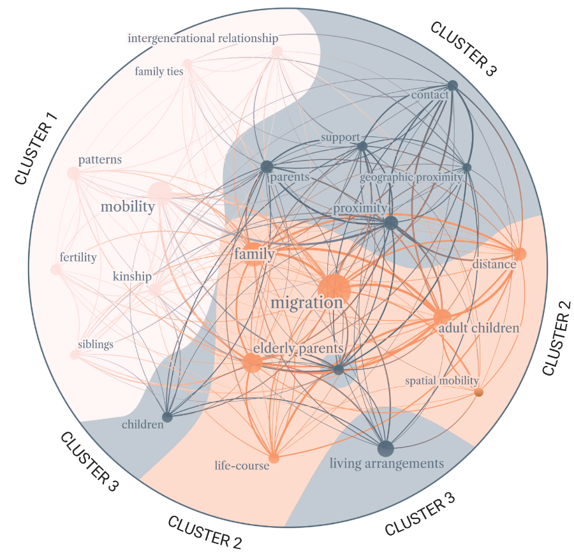
Family structures have undergone significant transformations, evolving from traditional nuclear models to more diverse and fragmented forms. While these shifts – driven by demographic changes, technological advancements, and evolving social norms – are fundamentally anchored in space, a "Geography of Family" remains methodologically dispersed and on the margins of mainstream research. This study employs a semi-automated computational mapping review, utilising ASReview and VOSviewer, to categorise how space is currently operationalised in explicitly spatial family-oriented research. The analysis identifies three primary conceptual clusters: space as a static context for social ties, space as a dynamic process of mobility, and space as a structural determinant of distance friction. Crucially, the review revealed that while micro-level family dynamics and macro-level structural conditions are well-documented, they are rarely simultaneously integrated into the same analytical models alongside active spatial metrics. Based on the mapped evidence, the study proposes a functional "triadic model" anchored in time, recommending a framework that systematically integrates micro-level ties, macro-level structures, and spatial dynamics. This approach enables the discipline to move beyond descriptive regional mappings towards robust causal explanations, advocating for the broader adoption of spatial tools such as Geographic Information Systems (GIS) to better understand kinship networks and intergenerational resilience in a changing world.
Highlights:
- Analysis identifies three clusters: Space as Context, Process, and Structure.
- Fragmented infrastructures and methodological nationalism constrain the field.
- Integrating spatial analysis tools can unlock causal explanations for family change.
Downloads




References
- Abalos, J. B., & Yeung, W.-J. J. (2023). Demographic, socioeconomic, and cultural factors for the rise in one-person households in developing countries: The case of the Philippines. Journal of Population Research, 40(4), 20. https://doi.org/10.1007/s12546-023-09312-z
- Abel, S., Machin, T., & Brownlow, C. (2021). Social media, rituals, and long-distance family relationship maintenance: A mixed-methods systematic review. New Media & Society, 23(3), 632–654. https://doi.org/10.1177/1461444820958717
- Alvarez, E. C., Kawachi, I., & Romani, J. R. (2017). Family social capital and health – a systematic review and redirection. Sociology of Health & Illness, 39(1), 5–29. https://doi.org/10.1111/1467-9566.12506
- Artamonova, A., & Gillespie, B. J. (2022). Older Adults’ Internal Migration Toward Faraway Siblings. The Journals of Gerontology: Series B, 77(7), 1336–1349. https://doi.org/10.1093/geronb/gbac011
- Artamonova, A., & Gillespie, B. J. (2023). Geographic proximity to siblings in older adulthood. Demographic Research, 49(7), 143–156. https://doi.org/10.4054/DemRes.2023.49.7
- ASReview LAB developers. (2025). ASReview LAB – A tool for AI-assisted systematic reviews (Version v2.2) [Computer software]. Zenodo. https://doi.org/10.5281/ZENODO.3345592
- Baldassar, L., Nedelcu, M., Merla, L., & Wilding, R. (2016). ICT-based co-presence in transnational families and communities: Challenging the premise of face-to-face proximity in sustaining relationships. Global Networks, 16(2), 133–144. https://doi.org/10.1111/glob.12108
- Bengtson, V. L. (2001). Beyond the Nuclear Family: The Increasing Importance of Multigenerational Bonds. Journal of Marriage and Family, 63(1), 1–16. https://doi.org/10.1111/j.1741-3737.2001.00001.x
- Bergsvik, J., Cools, S., & Hart, R. K. (2023). Explaining Residential Clustering of Large Families. European Journal of Population, 39(1), 13. https://doi.org/10.1007/s10680-023-09655-6
- Bernard, A., & Perales, F. (2024). The intergenerational transmission of migration capital: The role of family migration history and lived migration experiences. Demographic Research, 50(29), 827–870. https://doi.org/10.4054/DemRes.2024.50.29
- Bernstein, K., Raiber, F., Kurland, O., & Culpepper, J. S. (2020). Cluster-Based Document Retrieval with Multiple Queries. Proceedings of the 2020 ACM SIGIR on International Conference on Theory of Information Retrieval, 33–40. https://doi.org/10.1145/3409256.3409825
- Campbell, A. (2000). Cultural identity as a social construct. Intercultural Education, 11(1), 31–39. https://doi.org/10.1080/14675980050005370
- Coontz, S. (2004). The world historical transformation of marriage. Journal of Marriage and Family, 66(4), 974–979. https://doi.org/10.1111/j.0022-2445.2004.00067.x
- Chan, T. W., & Ermisch, J. (2015). Residential proximity of parents and their adult offspring in the United Kingdom, 2009–10. Population Studies, 69(3), 355–372. https://doi.org/10.1080/00324728.2015.1107126
- Chang, C. C. (2018). Hakka genealogical migration analysis enhancement using big data on library services. Library Hi Tech, 36(3), 426–442. https://doi.org/10.1108/LHT-08-2017-0172
- Choi, H., Schoeni, R. F., Wiemers, E. E., Hotz, V. J., & Seltzer, J. A. (2020). Spatial Distance Between Parents and Adult Children in the United States. Journal of Marriage and Family, 82(2), 822–840. https://doi.org/10.1111/jomf.12606
- Choi, H., Schoeni, R., Xu, H., Reyes, A., & Thomas, D. (2021). Proximity to mother over the life course in the United States: Overall patterns and racial differences. Demographic Research, 45(23), 769–806. https://doi.org/10.4054/DemRes.2021.45.23
- Clark, S., Madhavan, S., Cotton, C., Beguy, D., & Kabiru, C. (2017). Who Helps Single Mothers in Nairobi? The Role of Kin Support. Journal of Marriage and Family, 79(4), 1186–1204. https://doi.org/10.1111/jomf.12404
- Cotton, C., & Beguy, D. (2021). Long-Distance Mothering in Urban Kenya. Journal of Marriage and Family, 83(2), 482–497. https://doi.org/10.1111/jomf.12719
- Dykstra, P. A. (1995). Loneliness among the Never and Formerly Married: The Importance of Supportive Friendships and a Desire for Independence. The Journals of Gerontology: Series B, 50B(5), S321–S329. https://doi.org/10.1093/geronb/50B.5.S321
- Ermisch, J., & Mulder, C. H. (2019). Migration Versus Immobility, and Ties to Parents. European Journal of Population, 35(3), 587–608. https://doi.org/10.1007/s10680-018-9494-0
- Ferguson, S., Haartsen, T., Steinführer, A., & Catney, G. (2024). The role of non-resident family ties in rural staying. Population, Space and Place, 30(3), e2708. https://doi.org/10.1002/psp.2708
- Fingerman, K. L., Huo, M., & Birditt, K. S. (2020). A Decade of Research on Intergenerational Ties: Technological, Economic, Political, and Demographic Changes. Journal of Marriage and Family, 82(1), 383–403. https://doi.org/10.1111/jomf.12604
- Ghosh, A., Berg, V., Bhattacharya, K., Monsivais, D., Kertesz, J., Kaski, K., & Rotkirch, A. (2019). Migration patterns of parents, children and siblings: Evidence for patrilocality in contemporary Finland. Population, Space and Place, 25(5), e2208. https://doi.org/10.1002/psp.2208
- Gillespie, B. J., & van der Lippe, T. (2015). Intergenerational cohesiveness and later geographic distance to parents in the Netherlands. Advances in Life Course Research, 23, 56–66. https://doi.org/10.1016/j.alcr.2014.07.001
- Gruber, S., & Szołtysek, M. (2016). The patriarchy index: A comparative study of power relations across historical Europe. The History of the Family, 21(2), 133–174. https://doi.org/10.1080/1081602X.2014.1001769
- Gruijters, R. J. (2017). Intergenerational Contact in Chinese Families: Structural and Cultural Explanations. Journal of Marriage and Family, 79(3), 758–768. https://doi.org/10.1111/jomf.12390
- Hagestad, G. O. (1986). Dimensions of Time and the Family. American Behavioral Scientist, 29(6), 679–694. https://doi.org/10.1177/000276486029006004
- Huangfu, Y., & Nobles, J. (2022). Intergenerational support during the rise of mobile telecommunication in Indonesia. Demographic Research, 46(36), 1065–1108. https://doi.org/10.4054/DemRes.2022.46.36
- Kalmijn, M. (2021). Long-term trends in intergenerational proximity: Evidence from a grandchild design. Population, Space and Place, 27(8), e2473. https://doi.org/10.1002/psp.2473
- Kasakoff, A. B. (2019). The Changing Space of Families: A Genealogical Approach. Social Science History, 43(1), 1–29. Cambridge Core. https://doi.org/10.1017/ssh.2018.39
- Kaur, P., Permanyer Ugartemendia, I., & Esteve Palós, A. (2024). Research note: Continuity or change: Intergenerational patrilocal residence patterns among Indians in India and abroad (USA, UK, and Canada). Journal of Family Research, 36, 250–261. https://doi.org/10.20377/jfr-1036
- Kolk, M. (2017). A Life-Course Analysis of Geographical Distance to Siblings, Parents, and Grandparents in Sweden. Population, Space and Place, 23(3), e2020. https://doi.org/10.1002/psp.2020
- Koylu, C., Guo, D., Huang, Y., Kasakoff, A., & Grieve, J. (2021). Connecting family trees to construct a population-scale and longitudinal geo-social network for the U.S. International Journal of Geographical Information Science, 35(12), 2380–2423. https://doi.org/10.1080/13658816.2020.1821885
- Koylu, C., Guo, D., Kasakoff, A., & Adams, J. W. (2014). Mapping family connectedness across space and time. Cartography and Geographic Information Science, 41(1), 14–26. https://doi.org/10.1080/15230406.2013.865303
- Kulu, H., & Hannemann, T. (2016). Introduction to research on immigrant and ethnic minority families in Europe. Demographic Research, S18(2), 31–46. https://doi.org/10.4054/DemRes.2016.35.2
- Kyung-Sup, C. (2010). The second modern condition? Compressed modernity as internalized reflexive cosmopolitization. The British Journal of Sociology, 61(3), 444–464. https://doi.org/10.1111/j.1468-4446.2010.01321.x
- Lappegård, T., Klüsener, S., & Vignoli, D. (2018). Why are marriage and family formation increasingly disconnected across Europe? A multilevel perspective on existing theories. Population, Space and Place, 24(2), e2088. https://doi.org/10.1002/psp.2088
- Laslett, P. (1977). Characteristics of the Western Family Considered Over Time. Journal of Family History, 2(2), 89–115. https://doi.org/10.1177/036319907700200201
- Leydesdorff, L., & Welbers, K. (2011). The semantic mapping of words and co-words in contexts (arXiv:1011.5209). arXiv. https://doi.org/10.48550/arXiv.1011.5209
- Li, T., Liu, T., Liu, J., & Cheng, T. (2022). Spatial analyses of factors affecting household structure in Chinese cities: The case of three-generation lineal households. Journal of Geographical Sciences, 32(12), 2560–2576. https://doi.org/10.1007/s11442-022-2061-y
- Lynch, R., Schaffnit, S., Sear, R., Sosis, R., Shaver, J., Alam, N., Blumenfield, T., Mattison, S. M., & Shenk, M. (2022). Religiosity is associated with greater size, kin density, and geographic dispersal of women’s social networks in Bangladesh. Scientific Reports, 12(1), 18780. https://doi.org/10.1038/s41598-022-22972-w
- Madhavan, S., Clark, S., Araos, M., & Beguy, D. (2018). Distance or location? How the geographic distribution of kin networks shapes support given to single mothers in urban Kenya. The Geographical Journal, 184(1), 75–88. https://doi.org/10.1111/geoj.12230
- Madhavan, S., Mee, P., & Collinson, M. (2014). Kinship in Practice: Spatial Distribution of Children’s Kin Networks. Journal of Southern African Studies, 40(2), 401–418. https://doi.org/10.1080/03057070.2014.906211
- Miceli, A., & Bilecen, B. (2025). The Role of Family Ties in Mobility and Immobility Decisions: A Case Study of Italy. Population, Space and Place, 31(6), e70092. https://doi.org/10.1002/psp.70092
- Michielin, F., & Mulder, C. (2007). Geographical distances between adult children and their parents in the Netherlands. Demographic Research, S6(22), 655–678. https://doi.org/10.4054/DemRes.2007.17.22
- Mikolai, J., Mulder, C., & Kulu, H. (2020). Family life transitions, residential relocations, and housing in the life course: Current research and opportunities for future work: Introduction to the Special Collection on “Separation, Divorce, and Residential Mobility in a Comparative Perspective”. Demographic Research, S27(2), 35–58. https://doi.org/10.4054/DemRes.2020.43.2
- Mönkediek, B. (2020). Patterns of spatial proximity and the timing and spacing of bearing children. Demographic Research, 42(16), 461–496. https://doi.org/10.4054/DemRes.2020.42.16
- Mönkediek, B., Rotering, P., & Bras, H. (2017). Regional Differences in the Intergenerational Transmission of Family Size in Europe. Population, Space and Place, 23(2), e2003. https://doi.org/10.1002/psp.2003
- Monti, A., & Saarela, J. (2025). Geographical immobility and local ancestral ties: A study of three generations of natives in Finland. Geografiska Annaler: Series B, Human Geography, 107(2), 117–134. https://doi.org/10.1080/04353684.2023.2283102
- Mulder, C. (2018). Putting family centre stage: Ties to nonresident family, internal migration, and immobility. Demographic Research, S24(43), 1151–1180. https://doi.org/10.4054/DemRes.2018.39.43
- Oláh, L. Sz., Vignoli, D., & Kotowska, I. E. (2021). Gender Roles and Families. In K. F. Zimmermann (Ed.), Handbook of Labor, Human Resources and Population Economics (pp. 1–28). Springer International Publishing. https://doi.org/10.1007/978-3-319-57365-6_23-1
- Pesando, L. M., & GFC team. (2019). Global Family Change: Persistent Diversity with Development. Population and Development Review, 45(1), 133–168. https://doi.org/10.1111/padr.12209
- Reyes, A., Schoeni, R. F., & Choi, H. (2020). Race/Ethnic Differences in Spatial Distance Between Adult Children and Their Mothers. Journal of Marriage and Family, 82(2), 810–821. https://doi.org/10.1111/jomf.12614
- Sandow, E., & Lundholm, E. (2023). Leaving the City: Counterurbanisation and Internal Return Migration in Sweden. European Journal of Population, 39(1), 7. https://doi.org/10.1007/s10680-023-09649-4
- Schafer, M. H., & Sun, H. (2022). There at any distance? Geographic proximity and the presence of adult children in older Europeans’ core discussion networks. Social Science Research, 102, 102643. https://doi.org/10.1016/j.ssresearch.2021.102643
- Schönpflug, U. (2001). Intergenerational Transmission of Values: The Role of Transmission Belts. Journal of Cross-Cultural Psychology, 32(2), 174–185. https://doi.org/10.1177/0022022101032002005
- Smock, P. J., & Schwartz, C. R. (2020). The Demography of Families: A Review of Patterns and Change. Journal of Marriage and Family, 82(1), 9–34. https://doi.org/10.1111/jomf.12612
- Spring, A., Ackert, E., Crowder, K., & South, S. J. (2017). Influence of Proximity to Kin on Residential Mobility and Destination Choice: Examining Local Movers in Metropolitan Areas. Demography, 54(4), 1277–1304. https://doi.org/10.1007/s13524-017-0587-x
- Spring, A., Ackert, E., Roche, S., Parris, D., Crowder, K., & Kravitz-Wirtz, N. (2023). Keeping kin close? Geographies of family networks by race and income, 1981–2017. Journal of Marriage and Family, 85(4), 962–986. https://doi.org/10.1111/jomf.12911
- Therborn, G. (2004). Between Sex and Power: Family in the World 1900-2000 (1st ed.). Routledge. https://doi.org/10.4324/9780203643297
- Thomas, M. J., & Dommermuth, L. (2020). Internal Migration and the Role of Intergenerational Family Ties and Life Events. Journal of Marriage and Family, 82(5), 1461–1478. https://doi.org/10.1111/jomf.12678
- Li, T., Liu, T., Liu, J., & Cheng, T. (2022). Spatial analyses of factors affecting household structure in Chinese cities: The case of three-generation lineal households. Journal of Geographical Sciences, 32(12), 2560–2576. https://doi.org/10.1007/s11442-022-2061-yVan Eck, N. J., & Waltman, L. (2010). Software survey: VOSviewer, a computer program for bibliometric mapping. Scientometrics, 84(2), 523–538. https://doi.org/10.1007/s11192-009-0146-3
- Vergauwen, J., & Mortelmans, D. (2020). Parental health, informal support, and geographic mobility between parents and adult children. Population, Space and Place, 26(2), e2301. https://doi.org/10.1002/psp.2301
- Wu, X., & Yuan, Z. (2023). Understanding the socio-cultural resilience of rural areas through the intergenerational relationship in transitional China: Case studies from Guangdong. Journal of Rural Studies, 97, 303–313. https://doi.org/10.1016/j.jrurstud.2022.12.001
- Yang, J., & McDonnell, M. (2024). Social Structures and Family Systems: An Analysis of Cultural Influences. Journal of Psychosociological Research in Family and Culture, 2(1), 31–41. https://doi.org/10.61838/kman.jprfc.2.1.6
- Yeung, W.-J. J., & Cheung, A. K.-L. (2015). Living Alone: One-person households in Asia. Demographic Research, S15(40), 1099–1112. https://doi.org/10.4054/DemRes.2015.32.40
- Zilincikova, Z., & Schnor, C. (2023). Trends in Distance Between Non-resident Parents and Minor Children Following Separation: Analysis of the Belgian Case, 1992–2018. European Journal of Population, 39(1), 27. https://doi.org/10.1007/s10680-023-09674-3