
Recentring Peripheral Europe: Spatial Imaginaries and Regional Rescaling in the European Capital of Culture Programme
Published 2026-09-14
Keywords
- European Capital of Culture (ECoC),
- relational peripherality,
- spatial imaginaries,
- regional rescaling,
- symbolic de-peripheralisation
- territorial governance ...More
How to Cite
Copyright (c) 2026 Yi-De Liu

This work is licensed under a Creative Commons Attribution 4.0 International License.
Accepted 2026-09-13
Published 2026-09-14
Abstract
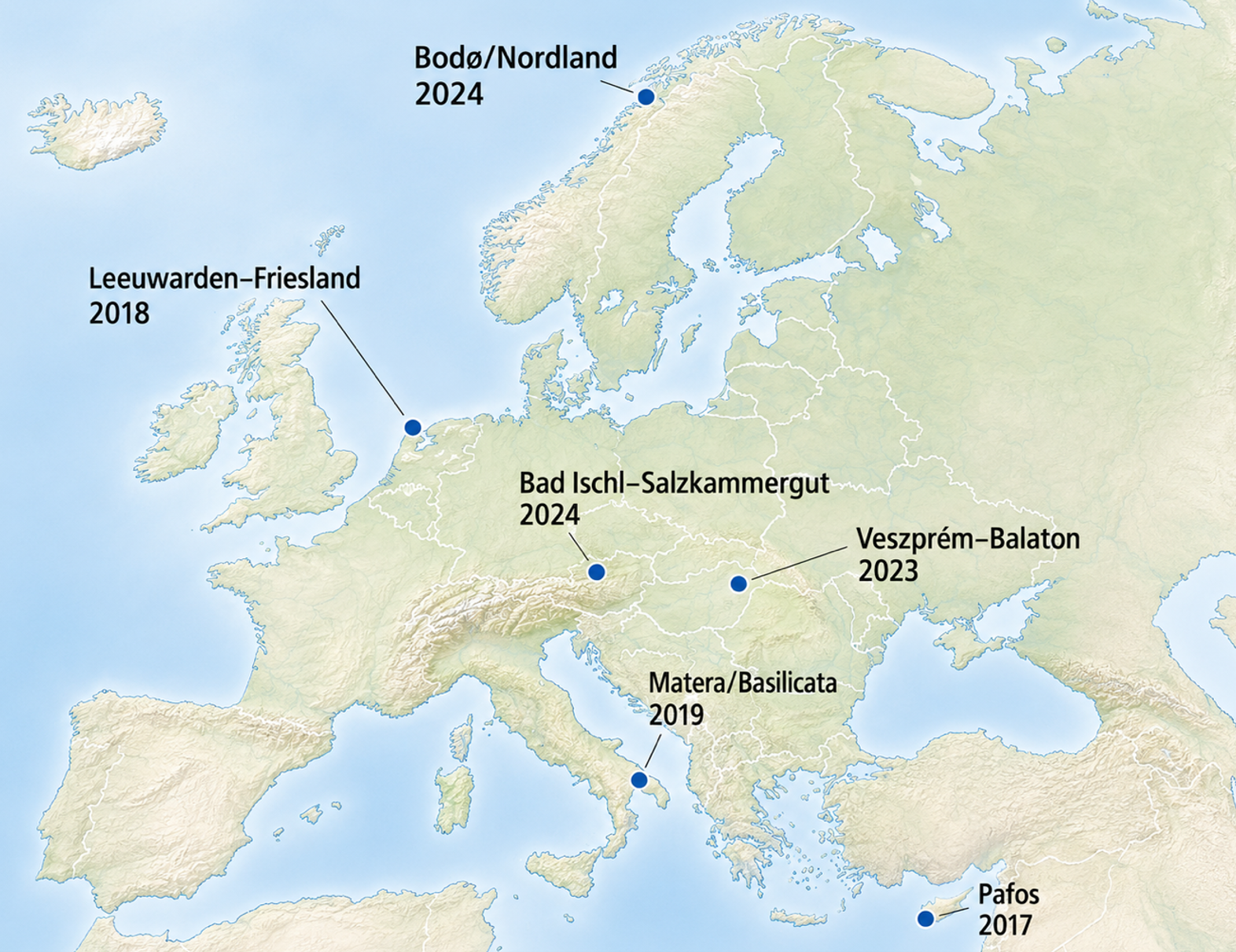
This article examines how the European Capital of Culture (ECoC) programme institutionally repositions peripheral places within European cultural geography. It asks how peripheral locations are revalued through spatial imaginaries, how city titles are rescaled into territorial platforms, and how symbolic recognition relates to the limits of structural change. A maximum-variation comparison of Matera/Basilicata 2019, Pafos 2017, Leeuwarden–Friesland 2018, Veszprém–Balaton 2023, Bad Ischl–Salzkammergut 2024 and Bodø/Nordland 2024 draws on 21 ECoC bid, selection, monitoring and ex-post evaluation documents, supplemented by peer-reviewed case research, regional survey data and other contextual evidence. The documents were coded through a transparent framework linking theoretical concepts, parent codes, subcodes, empirical indicators and evidentiary thresholds. Symbolic de-peripheralisation is identified only when spatial revaluation and institutional uptake coincide with either scalar repositioning or programme materialisation. The findings show how peripheral attributes are revalued as frontier, bridge, laboratory, open community or cultural landscape; translated into city-regional and multi-scalar programme structures; and selectively validated through the ECoC selection and monitoring system. Symbolic de-peripheralisation is therefore an institutional-discursive process, not evidence that peripherality has disappeared. It redistributes visibility and recognition, while documented resource and governance constraints, together with unresolved questions of mobility, regional distribution and temporal fragility, continue to delimit claims of structural change.
Highlights:
- A comparative framework links spatial theory, coding categories and documentary evidence.
- Symbolic de-peripheralisation requires spatial revaluation and institutional uptake, plus either territorial rescaling or programme materialisation.
- Symbolic recognition remains distinct from redistribution, mobility, governance capacity and durable territorial change.
Downloads




References
- Bad Ischl–Salzkammergut 2024. (2019). Culture is the new salt: European Capital of Culture 2024 final bid book. Bad Ischl–Salzkammergut 2024. https://www.salzkammergut-2024.at/wp-content/uploads/2022/11/kulturhauptstadt-salzkammergut-bid-book-englisch.pdf
- Bodø 2024. (2019). Midsummer madness, autumn storms, Arctic light: Bodø 2024 final bid book. Bodø 2024. https://culturenext.eu/ecoc-archive/
- Brenner, N. (2001). The limits to scale? Methodological reflections on scalar structuration. Progress in Human Geography, 25(4), 591–614. https://doi.org/10.1191/030913201682688959
- Brenner, N. (2004). New state spaces: Urban governance and the rescaling of statehood. Oxford University Press.
- Copus, A. K. (2001). From core-periphery to polycentric development: Concepts of spatial and aspatial peripherality. European Planning Studies, 9(4), 539–552. https://doi.org/10.1080/713666491
- Cox, K. R. (1998). Spaces of dependence, spaces of engagement and the politics of scale, or: Looking for local politics. Political Geography, 17(1), 1–23. https://doi.org/10.1016/S0962-6298(97)00048-6
- Dova, E., Sivitanidou, A., Anastasi, N. R., & Tzortzi, J. G.-N. (2022). A mega-event in a small city: Community participation, heritage and scale in the case of Pafos 2017 European Capital of Culture. European Planning Studies, 30(3), 457–477. https://doi.org/10.1080/09654313.2021.1959721
- European Capital of Culture Expert Panel. (2014). Selection report: European Capital of Culture 2019 in Italy. European Commission. https://culture.ec.europa.eu/document/selection-report-european-capital-of-culture-2019-italy
- European Capital of Culture Expert Panel. (2015a). First monitoring report: European Capital of Culture 2018 in the Netherlands. European Commission. https://culture.ec.europa.eu/document/first-monitoring-report-european-capital-of-culture-2018-netherlands
- European Capital of Culture Expert Panel. (2015b). Selection report: European Capital of Culture 2017 in Cyprus. European Commission. https://culture.ec.europa.eu/document/selection-report-european-capital-of-culture-2017-cyprus
- European Capital of Culture Expert Panel. (2016). Second monitoring report: European Capital of Culture 2017 in Cyprus. European Commission. https://culture.ec.europa.eu/document/second-monitoring-report-european-capital-of-culture-2017-cyprus
- European Capital of Culture Expert Panel. (2017). Second monitoring report: European Capital of Culture 2018 in the Netherlands. European Commission. https://culture.ec.europa.eu/document/second-monitoring-report-european-capital-of-culture-2018-netherlands
- European Capital of Culture Expert Panel. (2018). Selection report: European Capital of Culture 2023 in Hungary. European Commission. https://culture.ec.europa.eu/document/selection-report-european-capital-of-culture-2023-hungary
- European Capital of Culture Expert Panel. (2020). Veszprém European Capital of Culture 2023: First monitoring report. European Commission. https://culture.ec.europa.eu/resources/document-library/first-monitoring-report-european-capital-of-culture-2023-hungary
- European Capital of Culture Expert Panel. (2021). First monitoring report: European Capital of Culture 2024 in Norway. European Commission. https://culture.ec.europa.eu/document/first-monitoring-report-european-capital-of-culture-2024-norway
- European Capital of Culture Expert Panel. (2022a). Bad Ischl European Capital of Culture 2024: Second monitoring report. European Commission. https://culture.ec.europa.eu/document/second-monitoring-report-european-capital-of-culture-2024-austria
- European Capital of Culture Expert Panel. (2022b). Bodø 2024: Second monitoring report. European Commission. https://culture.ec.europa.eu/document/second-monitoring-report-european-capital-of-culture-2024-norway
- European Capital of Culture Expert Panel. (2022c). Veszprém European Capital of Culture 2023: Second monitoring report. European Commission. https://culture.ec.europa.eu/document/second-monitoring-report-european-capital-of-culture-2023-hungary
- European Capital of Culture Expert Panel. (2023). Bad Ischl European Capital of Culture 2024: Third monitoring report. European Commission. https://culture.ec.europa.eu/document/third-monitoring-report-european-capital-of-culture-2024-austria
- European Commission. (2009). Ex post evaluation of the European Capital of Culture event 2007 (Luxembourg and Sibiu) and 2008 (Liverpool and Stavanger). https://eur-lex.europa.eu/legal-content/EN/TXT/?uri=CELEX:52009DC0689
- European Commission. (2015). Ex post evaluation of the 2013 European Capitals of Culture (Košice and Marseille-Provence). https://eur-lex.europa.eu/legal-content/EN/TXT/?uri=CELEX:52015DC0074
- European Commission. (2018). Ex-post evaluation of the 2017 European Capitals of Culture: Final report. Publications Office of the European Union. https://doi.org/10.2766/629848
- European Commission. (2019). Ex-post evaluation of the 2018 European Capitals of Culture: Final report. Publications Office of the European Union. https://doi.org/10.2766/274860
- European Commission. (2020a). Commission staff working document: Ex post evaluation of the 2018 European Capitals of Culture (Leeuwarden and Valletta). https://eur-lex.europa.eu/legal-content/EN/TXT/?uri=CELEX:52020SC0165
- European Commission. (2020b). Ex-post evaluation of the 2019 European Capitals of Culture: Final report. Publications Office of the European Union. https://doi.org/10.2766/30822
- European Commission. (2021). Commission staff working document: Ex post evaluation of the 2019 European Capitals of Culture (Matera and Plovdiv). https://eur-lex.europa.eu/legal-content/EN/TXT/?uri=CELEX:52021SC0232
- Farmaki, A., Christou, P., Saveriades, A., & Spanou-Tripinioti, E. (2019). Perceptions of Pafos as European Capital of Culture: Tourism stakeholder and resident perspectives. International Journal of Tourism Research, 21(2), 234–244. https://doi.org/10.1002/jtr.2257
- Fischer-Tahir, A., & Naumann, M. (Eds.). (2013). Peripheralization: The making of spatial dependencies and social injustice. Springer VS.
- Fondazione Matera Basilicata 2019. (2019). Matera 2019: Open Future. https://www.matera-basilicata2019.it/en/progetti/matera-2019-open-future-2/
- Fondazione Matera Basilicata 2019. (2021a). Cultural citizenship. Matera 2019 Open Data Platform. https://opendata.matera-basilicata2019.it/en/cultural-citizenship/
- Fondazione Matera Basilicata 2019. (2021b). The volunteers at Matera 2019. Matera 2019 Open Data Platform. https://opendata.matera-basilicata2019.it/en/stories/volounteers/
- García, B., & Cox, T. (2013). European Capitals of Culture: Success strategies and long-term effects. European Parliament. https://doi.org/10.2861/4689
- Harvey, D. (1973). Social justice and the city. Johns Hopkins University Press.
- Jones, R., Goodwin-Hawkins, B., & Woods, M. (2020). From territorial cohesion to regional spatial justice: The Well-being of Future Generations Act in Wales. International Journal of Urban and Regional Research, 44(5), 894–912. https://doi.org/10.1111/1468-2427.12909
- Jones, Z. M., & Zhang, X. (2024). Identifying the role of industrial heritage in the European Capital of Culture programme. Built Heritage, 8, Article 20. https://doi.org/10.1186/s43238-024-00133-4
- Kajdanek, K., Błaszczyk, M., & Banaszak, E. (2024). Breaking open the black box of narratives on European Capital of Culture: Social positioning, cultural participation, and success and failure stories (case of ECoC Wrocław 2016). International Journal of Cultural Policy, 30(5), 647–666. https://doi.org/10.1080/10286632.2023.2244516
- Kühn, M. (2015). Peripheralization: Theoretical concepts explaining socio-spatial inequalities. European Planning Studies, 23(2), 367–378. https://doi.org/10.1080/09654313.2013.862518
- Lähdesmäki, T. (2014a). European Capital of Culture designation as an initiator of urban transformation in the post-socialist countries. European Planning Studies, 22(3), 481–497. https://doi.org/10.1080/09654313.2012.752438
- Lähdesmäki, T. (2014b). Discourses of Europeanness in the reception of the European Capital of Culture events: The case of Pécs 2010. European Urban and Regional Studies, 21(2), 191–205. https://doi.org/10.1177/0969776412448092
- Lähdesmäki, T., Mäkinen, K., Čeginskas, V. L. A., & Kaasik-Krogerus, S. (2021). EU cultural policy: Europe from above. In Europe from below: Notions of Europe and the European among participants in EU cultural initiatives (pp. 55–82). Brill. https://doi.org/10.1163/9789004449800_003
- Lang, T. (2012). Shrinkage, metropolization and peripheralization in East Germany. European Planning Studies, 20(10), 1747–1754. https://doi.org/10.1080/09654313.2012.713336
- Lang, T. (2015). Socio-economic and political responses to regional polarisation and socio-spatial peripheralisation in Central and Eastern Europe: A research agenda. Hungarian Geographical Bulletin, 64(3), 171–185. https://doi.org/10.15201/hungeobull.64.3.2
- Leeuwarden–Friesland 2018. (2013). Iepen mienskip: Final selection bid book. CultureNext ECoC Archive. https://culturenext.eu/ecoc-archive/
- Liu, Y.-D. (2024). The European Capital of Culture and transnational networks. European Review, 32(1), 1–15. https://doi.org/10.1017/S106279872300056X
- Liu, Y.-D. (2026). Shaping Europeanness in the European Capitals of Culture. European Review, 34(1), 1–15. https://doi.org/10.1017/S106279872610060X
- Massey, D. (1994). Space, place and gender. Polity.
- Massey, D. (2005). For space. SAGE.
- Matera 2019. (2014). Open future: Final selection bid book. CultureNext ECoC Archive. https://culturenext.eu/ecoc-archive/
- Moldovan, M. (2025). The dynamics of EU cultural policies in post-socialist urban regeneration strategies: A case study of Timișoara—European Capital of Culture 2023. International Journal of Cultural Policy, 31(3), 358–370. https://doi.org/10.1080/10286632.2024.2360440
- Nelaeva, A., & Iermolenko, O. (2024). Do we hear the voices of local citizens when we arrange cultural megaprojects for them? A case of the European Capitals of Culture. Cities, 152, 105227. https://doi.org/10.1016/j.cities.2024.105227
- Paasi, A. (1986). The institutionalization of regions: A theoretical framework for understanding the emergence of regions and the constitution of regional identity. Fennia: International Journal of Geography, 164(1), 105–146. https://fennia.journal.fi/article/view/9052
- Paasi, A. (2002). Place and region: Regional worlds and words. Progress in Human Geography, 26(6), 802–811. https://doi.org/10.1191/0309132502ph404pr
- Paasi, A. (2010). Regions are social constructs, but who or what “constructs” them? Environment and Planning A: Economy and Space, 42(10), 2296–2301. https://doi.org/10.1068/a42232
- Pafos 2017. (2012). Linking continents—bridging cultures: Final selection bid book. CultureNext ECoC Archive. https://culturenext.eu/ecoc-archive/
- Regione Basilicata. (2020). Matera 2019: Results of the demographic survey. https://www.regione.basilicata.it/matera-2019-presentati-i-risultati-dellindagine-demoscopica/
- Richards, G., & Palmer, R. (2010). Eventful cities: Cultural management and urban revitalisation. Butterworth-Heinemann.
- Soja, E. W. (2010). Seeking spatial justice. University of Minnesota Press.
- Swyngedouw, E. (1997). Neither global nor local: “Glocalization” and the politics of scale. In K. R. Cox (Ed.), Spaces of globalization: Reasserting the power of the local (pp. 137–166). Guilford Press.
- Veszprém–Balaton 2023. (2018). European Capital of Culture 2023 candidate city bid book. Veszprém–Balaton 2023. https://veszprembalaton2023.hu/blob/veszprem2023-ecoc-bidbook-en.pdf