
Engaging with the Wickedness of Education for Sustainable Development through Multimodal Vignettes in Teacher Education
Published 2026-07-23
Keywords
- Wicked Problems,
- Education for Sustainable Development,
- Teacher Professionalisation,
- Teacher Education,
- Vignettes
How to Cite
Copyright (c) 2026 Elena Flucher, Pauline Hennig, Tom Wils, Nicole Raschke; Fabian Pettig

This work is licensed under a Creative Commons Attribution 4.0 International License.
Accepted 2026-07-18
Published 2026-07-23
Abstract
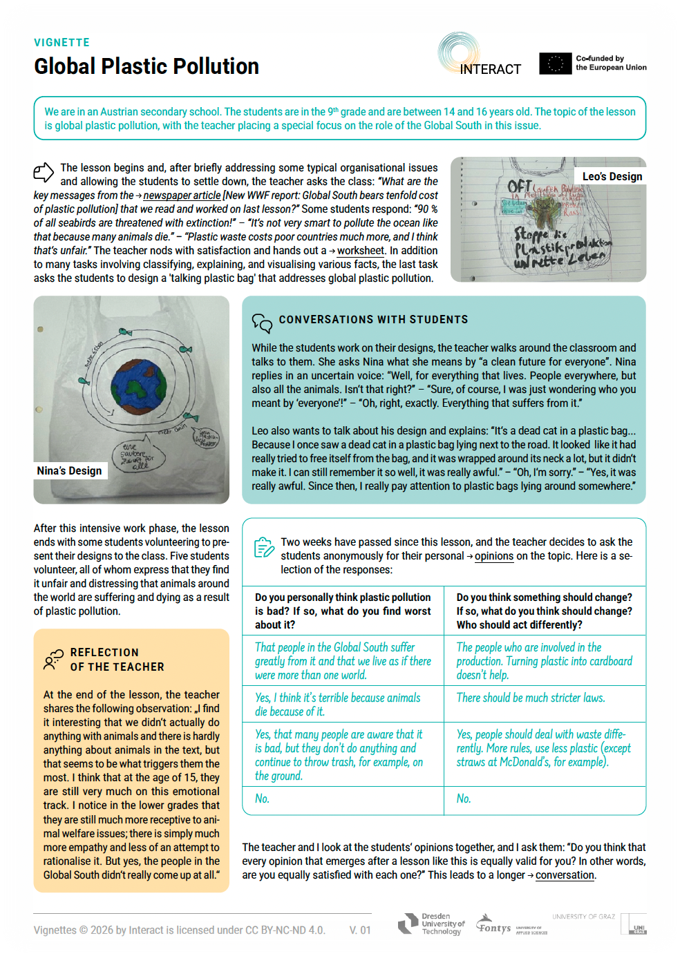
This paper conceptualises Education for Sustainable Development (ESD) as a Wicked Problem and highlights the need to explicitly address its inherent controversy in geography teacher education. To engage with the content-related, pedagogical, and structural dimensions of this Wickedness as they intersect in everyday classroom practices, we propose multimodal vignettes as a promising casuistic tool for reflection. Drawing on the international project INTERACT, the paper outlines the construction of these vignettes and illustrates the approach through one specific vignette. First experiences from using the vignette corpus in different seminar contexts suggest that multimodal vignettes may support a shift away from solution-orientated approaches towards more reflexive engagement with the complexity, uncertainty, and contested nature of sustainability-related teaching.
Highlights:
- Wickedness of Education for Sustainable Development (ESD) as an analytical framework
- Multimodal vignettes as a tool for reflexive professionalisation in teacher education
- Supporting reflexive engagement with complexity, uncertainty, and controversy in ESD
Contribution to the Special Issue Topics: As geography education seeks to prepare learners for an increasingly uncertain, fragmented, and contested world, teachers require opportunities to engage reflexively with complexity, uncertainty, and controversy. By conceptualising ESD as a Wicked Problem and proposing multimodal vignettes as a casuistic approach, this paper contributes to debates on pedagogies for complexity, uncertainty, and teacher agency in geography teacher education.
Downloads




References
- Agostini, E., & Peterlini, H. K. (2022). Vignette research. An Austrian phenomenological approach to empirical research. In T. Feldges (Ed.), Education in Europe. Contemporary Approaches across the Continent (pp. 130–140). Routledge. https://doi.org/10.4324/9781003223528
- Bengtsson S., Hansson P., Håkansson M., & Östman L. (2024). Positioning controversy in environmental and sustainability education. Environmental Education Research, 30(9), 1405–1431. https://doi.org/10.1080/13504622.2024.2347868
- Biesta, G. J. J. (2013). The Beautiful Risk of Education. Routledge. https://doi.org/10.4324/9781315635866
- Block, T., Van Poeck, K., & Östman, L. (2019). Tackling wicked problems in teaching and learning. Sustainability issues as knowledge, ethical and political challenges. In K. van Poeck, L. Östman & J. Öhman (Eds.), Sustainable Development Teaching: Ethical and Political Challenges (pp. 28–39). Routledge. https://doi.org/ 10.4324/9781351124348-3
- Brand U., & Wissen M. (2021). The imperial mode of living. Everyday Life and the Ecological Crisis of capitalism. Verso Books.
- Breitenmoser, P., Keller-Schneider, M., & Niebert, K. (2024). Navigating controversy and neutrality: pre-service teachers’ beliefs on teaching climate change. Environmental Education Research, 31(11), 2097–2115. https://doi.org/10.1080/13504622.2024.2375335
- Costa, J., & Singer-Brodowski, M. (2024). Fridays for Future: Dealing with controversial issues in schools. GAIA, 33(3), 306–313. https://doi.org/10.14512/gaia.33.3.6
- Darling-Hammond, L., & Hammerness, K. (2002). Toward a Pedagogy of Cases in Teacher Education. Teaching Education, 13(2), 125–135. https://doi.org/10.1080/1047621022000007549
- Felix, S. M., & Clayton, S. (2025). Describing teachers’ environmental identity as part of education for sustainable development. Environmental Education Research, 31(7), 1389–1406. https://doi.org/10.1080/13504622.2025.2482740
- Hanke, M., Paseka, A. & Sprenger, S. (2023). Understanding the meaning of uncertainty in geography education: a systematic review. Teachers and Teaching, 31(2), 174–200. https://doi.org/10.1080/13540602.2023.2263375
- Hemmer, I., Wittlich, C., & Schult, B. (2025). Welchen Stellenwert hat Geographie bei der Implementierung von BNE in der Schule im Fächervergleich? Erkenntnisse eines systematischen Reviews zu empirischen Befunden. Zeitschrift für Geographiedidaktik (ZGD), 53, 48–75. https://doi.org/10.60511/53490
- Hess, D., & McAvoy, P. (2015). The political classroom. Routledge. https://doi.org/10.4324/9781315738871
- Jeffries, C., & Maeder D. W. (2005). Using Vignettes To Build and Assess Teacher Understanding of Instructional Strategies. The Professional Educator, 27(2), 17–28.
- Karousiou, C., Vrikki, M., & Evagorou M. (2025). Teachers’ perceptions on introducing sensitive and controversial issues in the classroom. Frontiers in Education, 10, 1481173. https://doi.org/10.3389/feduc.2025.1481173
- Laub, J. (2022). Education, Sustainability and Responsibility – Pedagogic Antinomies for Prospective Teachers? Interdisciplinary Journal of Environmental and Science Education, 18(3), e2278. https://doi.org/10.21601/ijese/12015
- Lönngren, J., & van Poeck, K. (2021). Wicked problems: a mapping review of the literature. International Journal of Sustainable Development & World Ecology, 28(6), 481–502. https://doi.org/10.1080/13504509.2020.1859415
- Meadows, M. E. (2020). Geography Education for Sustainable Development. Geography and Sustainability, 1(1), 88–92. https://doi.org/10.1016/j.geosus.2020.02.001
- Mitchell, J. T. (2022). Teaching the “Wicked” in Geography: Educational Structure, Standards, and Teacher Training as Obstacles to Teaching about Climate Change. Journal of the South Carolina Academy of Science, 20(1), 19–20. https://scholarcommons.sc.edu/cgi/viewcontent.cgi?article=1235&context=jscas
- Murphy, R. (2012). Sustainability: A Wicked Problem. Sociologica, 2, 1–24. https://doi.org/10.2383/38274
- Östman, L., Poeck, K. van & Öhman, J. (2019). Principles for sustainable development teaching. In K. van Poeck, L. Östman & J. Öhman (Eds.), Sustainable Development Teaching: Ethical and Political Challenges (pp. 40–56). Routledge.
- Pettig, F., & Singer-Brodowski, M. (2025). Learning in Relation with a Changing World: Thinking Beyond ESD 1 and ESD 2 Towards ESD 3. Journal of Education for Sustainable Development, 18(2), 176–201. https://doi.org/10.1177/09734082251347383
- Rittel, H., & Webber, M. (1973). Dilemmas in a General Theory of Planning. Policy Sciences, 4, 155–169.
- Schlieszusg, A. K., Weselek, J., & Siegmund, A. (2024). Navigating role conflicts and responsibilities in higher education for sustainable development. Insights from German university teachers. GAIA, 33(4), 363–371. https://doi.org/10.14512/gaia.33.4.7
- Schmidt, R. & Wittek, D. (2020). Reflexion und Kasuistik. Systematisierung kasuistischer Lehr-Lern-Formate und deren Zieldimension der Reflexion. HLZ – Herausforderung Lehrer*innenbildung, 3(2), 29–44. https://doi.org/10.4119/hlz-2489
- Schratz, M., Schwarz, J., & Westfall-Greiter, T. (2013). Looking At Two Sides Of The Same Coin: Phenomenologically Oriented Vignette Research And Its Implications For Teaching And Learning. Studia paedagogica, 18(4), 57–73. https://doi.org/10.5817/SP2013-4-4
- Skou Grindsted, T. (2013). From The Human-Environment Theme Towards Sustainability – Danish Geography and Education for Sustainable Development. European Journal of Geography, 4(3), 6–20.
- Ulvik, M., Eide, H. M. K., Eide, L., Helleve, I., Jensen, V. S., Ludvigsen, K., Roness, D., & Torjussen, L. P. S. (2022). Teacher educators reflecting on case-based teaching – a collective self-study. Professional Development in Education, 48(4), 657–671. https://doi.org/10.1080/19415257.2020.1712615
- Vare, P., & Scott, W. (2007). Learning for a change: Exploring the Relationship Between Education and Sustainable Development. Journal of Education for Sustainable Development 1(2), 191–198. https://doi.org/10.1177/097340820700100209