
Published 2026-08-08
Keywords
- assessment,
- Future 3 curriculum,
- epistemic access,
- powerful disciplinary knowledge,
- teacher agency
How to Cite
Copyright (c) 2026 Emma Rawlings Smith, Uwe Krause

This work is licensed under a Creative Commons Attribution 4.0 International License.
Accepted 2026-07-19
Published 2026-08-08
Abstract
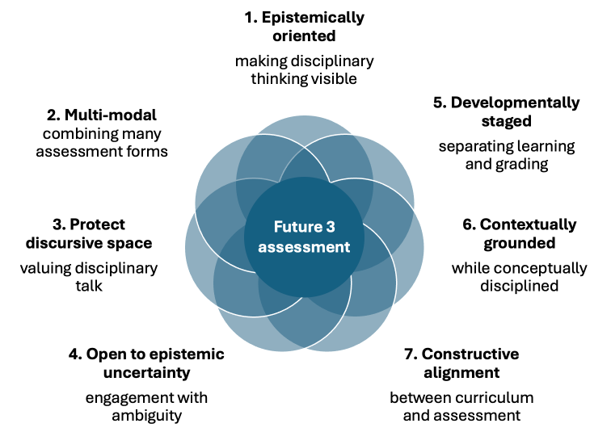
A future-orientated liberatory curriculum has the potential to equip children and young people with the knowledge, understanding and capabilities needed to understand and navigate our complex and rapidly changing world. This is only possible if we support students to develop intellectually powerful ways of thinking, understanding, analysing, explaining and finding out, paired with complementary assessment practices. Much existing literature on powerful knowledge is focused on curriculum thinking (what should be taught) rather than on assessment (how learning is measured). This is a significant omission, given the powerful influence of assessment on curriculum enactment and classroom practice. This theoretical paper identifies persistent tensions between curriculum intentions that emphasise conceptual understanding, relational thinking and epistemic engagement and assessment regimes that prioritise coverage, predictability and measurability. Next, it contends that for a Future 3 curriculum to be fully realised, assessment practices must be re‑imagined, recognising complex disciplinary performances rather than isolated forms of propositional knowledge. The paper concludes by outlining seven key principles for assessment design aligned with Future 3 curriculum thinking and illustrates these through examples drawn from upper secondary geography across international education systems.
Highlights:
- Curriculum and assessment systems shape access to powerful disciplinary knowledge in geography education.
- Seven design principles are presented that align future 3 curriculum and assessment.
- International insights are used to evidence how Future 3 assessment can be realised.
Contribution to the Special Issue Topics: This article contributes to the themes of powerful geographical knowledge and navigating epistemic uncertainty and complexity. It argues that realising a Future 3 curriculum depends on assessment practices that align with its aims and examines what such assessment might look like. It proposes seven design principles that recognise disciplinary reasoning, epistemic engagement, complexity and multiple legitimate interpretations and illustrates these through international examples.
Downloads




References
- AQA. (2011). GCE AS and A Level Specification: Geography. AQA. https://www.antarcticglaciers.org/wp-content/uploads/2012/06/AQA-2030-W-SP-10.pdf
- Bendl, T., Krajňáková, L., Marada, M., & Řezníčková, D. (2025). Geographical thinking in geography education: a systematic review. International Research in Geographical and Environmental Education, 34(4), 326–352. https://doi.org/10.1080/10382046.2024.2354097
- Béneker, T. (2018, 16 October). Powerful knowledge in geography education. Inaugural Professorial Lecture, Faculty of Geosciences, Utrecht University. Available at: https://www.uu.nl/sites/default/files/20190319-inaugural_lecture-tine_beneker.pdf
- Béneker, T., Bladh, G., & Lambert, D. (2024). Exploring ‘Future three’ curriculum scenarios in practice: Learning from the GeoCapabilities project. The Curriculum Journal, 35(3), 396–411. https://doi.org/10.1002/curj.240
- Béneker, T., & van der Vaart, R. (2020). The knowledge curve: Combining types of knowledges leads to powerful thinking. International Research in Geographical and Environmental Education, 29(3), 221–231. https://doi.org/10.1080/10382046.2020.1749755
- Bernstein, B. (1999). Vertical and horizontal discourse: An essay. British Journal of Sociology of Education, 20(2), 157–173. https://doi.org/10.1080/01425699995380
- Bernstein, B. (2000). Pedagogy, symbolic control and identity: Theory, research, critique (revised edn). Rowman and Littlefield.
- Biesta, G. (2015). Beautiful risk of education. Routledge https://doi.org/10.4324/9781315635866
- Biesta, G. (2020, Oct 21). Hoogleraar Gert Biesta over de brede taak van de school: ‘Kinderen moeten zichzelf tegenkomen in het onderwijs’. PO-Raad. https://www.poraad.nl/onderwijskwaliteit/schoolontwikkeling/onderwijs-en-onderzoek/hoogleraar-gert-biesta-over-de-brede
- Biesta, G. (2022). World-centred education: A view for the present. Routledge.
- Biggs, J. B. (1996). Enhancing teaching through constructive alignment. Higher Education, 32, 347-364. https://doi.org/10.1007/BF00138871
- Bijsterbosch, E., van der Schee, J., & Kuiper, W. (2017). Meaningful learning and summative assessment in geography education: an analysis in secondary education in the Netherlands. International Research in Geographical and Environmental Education, 26(1), 17–35. https://doi.org/10.1080/10382046.2016.1217076
- Bustin, R. (2019). Geography education’s potential and the capability approach. Palgrave Macmillan.
- Catling, S., & Lee, J. (2017). What do geography textbook authors in England consider when they design content and select case studies? International Research in Geographical and Environmental Education, 26(4), 342-356. https://doi.org/10.1080/10382046.2016.1220125
- Hoffmann, K. W. (Ed.). (2021). Lernaufgaben im geographieunterricht. Sieben phasen zur schüleraktivierung. [Learning tasks in geography lessons. Seven phases to activate students.]. Westermann.
- Hordern, J. (2021). Recontextualisation and the teaching of subjects. The Curriculum Journal, 32(4), 592–606. https://doi.org/10.1002/curj.110
- Ketonen, L., & Nieminen, J. H. (2026). Professional autonomy vs. assessment criteria: teacher agency in the midst of assessment reform. Journal of Curriculum Studies, 58(2), 257–274. https://doi.org/10.1080/00220272.2025.2460476
- Jackson, P. (2006). Thinking geographically. Geography, 91(3), 199–204. https://doi.org/10.1080/00167487.2006.12094167
- Krause, U. (2025). The Role of higher-order thinking tasks in the teaching repertoires of Dutch and German geography teachers: Exploring the impact of curriculum contexts. [Doctoral thesis 1 (Research UU / Graduation UU), Universiteit Utrecht]. Utrecht University. https://doi.org/10.33540/2854
- Krause, U., Rawlings Smith, E., Flajshans Nedbalova, R., He, X., He, Y., Ito, N., Milaras, M., Yang, J., Hanus M., & Béneker, T. (2025). The barriers and enablers of curriculum thinking and teacher agency in geography education: a multinational study. International Research in Geographical and Environmental Education, 34(3), 220–236. https://doi.org/10.1080/10382046.2025.2466160
- Krause, U., Béneker, T., van Tartwijk, J., & Güngör, D. (2024). Influences on the task-setting practices of geography teachers: orientations and curriculum contexts. International Research in Geographical and Environmental Education, 35(1), 25–39. https://doi.org/10.1080/10382046.2024.2363642
- Krause, U., Béneker, T., van Tartwijk, J., & Maier, V. (2021). Curriculum contexts, recontextualisation and attention for higher-order thinking. London Review of Education, 19(1), 1–17. https://doi.org/10.14324/LRE.19.1.24
- Lane, R., & Bourke, T. (2019). Assessment in geography education: a systematic review. International Research in Geographical and Environmental Education, 28(1), 22–36. https://doi.org/10.1080/10382046.2017.1385348
- Maton, K. (2014). Knowledge and Knowers. Towards a Realist Sociology of Education. Routledge.
- Maude, A. (2016). What might powerful geographical knowledge look like? Geography, 101(2), 70–76. https://doi.org/10.1080/00167487.2016.12093987
- Maude, A. (2017). Geography and powerful knowledge: a contribution to the debate. International Research in Geographical and Environmental Education, 27(2), 179–190. https://doi.org/10.1080/10382046.2017.1320899
- Maude, A. (2020). The role of geography’s concepts and powerful knowledge in a future 3 curriculum. International Research in Geographical and Environmental Education, 29(3), 232–243. https://doi.org/10.1080/10382046.2020.1749771
- Mehren, M., & Mehren, R. (2020). Über die tiefenstrukturen des (Geographie-) Unterrichts. [About the deep structure of (geography) lessons.]. Praxis Geographie, 50(4), 4-9. https://www.fachportal-paedagogik.de/literatur/vollanzeige.html?FId=3352201
- Ministerium für Schule und Weiterbildung des Landes Nordrhein-Westfalen [MfSuW NRW] (2014). Kernlehrplan für die Sekundarstufe II Gymnasium/Gesamtschule in Nordrhein-Westfalen. [Core curriculum for secondary level II Gymnasium/comprehensive school in North Rhine-Westphalia.] Ministerium für Schule und Weiterbildung des Landes Nordrhein-Westfalen. Available at: http://curricula-depot.gei.de/handle/11163/610
- Ministry of Education (MoE) Singapore. (2023). Upper secondary geography syllabus. Curriculum Planning and Development Division. https://www.moe.gov.sg/api/media/eb95a148-9ef9-43a6-92c1-65353b0d3ab8/2023-Upper-Secondary-Geography-Syllabus.pdf
- Moore, R. (2007). Sociology of knowledge and education. Continuum.
- Ng, D. F. S., & Chua, J. (2023). Future-readiness in education. Asia Pacific Journal of Education, 43(3), 633–647. https://doi.org/10.1080/02188791.2023.2236421
- OECD (2019). Transformative competencies for 2030. https://www.oecd.org/content/dam/oecd/en/about/projects/edu/education-2040/concept-notes/Transformative_Competencies_for_2030_concept_note.pdf
- Rawlings Smith, E., & Kinder, S. (2022). The professional needs and views of teachers of geography: A national report. Geographical Association.
- Rawlings Smith, E., & Pike, S. (eds) (2023). Encountering ideas of place in education: Scholarship and practice in place-based education. Routledge. https://doi.org/10.4324/9781003386162
- Rawlings Smith, E., Mayo-Holloway, C., Healy, G., & Jones, R. (2026). The Importance of Connecting Young People, School Geography and Future Careers in Secondary Education. European Journal of Geography, 17(2), S.114-S.127. https://doi.org/10.48088/ejg.e.smi.17.2.114.127
- Ritchhart, R., Church, M., & Morrison, K. (2011). Making thinking visible: How to promote engagement, understanding and independence for all learners. Jossey-Bass.
- Roberts, M. (2023a). Geography through enquiry. Approaches to teaching and learning in the secondary school (2nd edn.). Geographical Association.
- Roberts, M. (2023b). Powerful pedagogies for the school geography curriculum. International Research in Geographical and Environmental Education, 32(1), 69–84. https://doi.org/10.1080/10382046.2022.2146840
- Sherwood, D. (2022). Missing the mark: Why so many school exam grades are wrong – and how to get results we can trust. Canbury Press.
- Tran, D., & O’Connor, B. R. (2024). Teacher curriculum competence: how teachers act in curriculum making. Journal of Curriculum Studies, 56(1), 1–16. https://doi.org/10.1080/00220272.2023.2271541
- van Beveren, K., Karkdijk, J., Wevers, I., Krause, U., & Beneker, T. (2025). Geografisch redeneren in de praktijk: Stap voor stap naar een krachtige les. [Geographical reasoning in practice: step by step towards a powerful lesson]. Geografie, 6, 31-35. https://geografie.nl/artikel/geografisch-redeneren-in-de-praktijk
- van den Akker, J. (2003). Curriculum perspectives: An introduction. In J. van den Akker, W. Kuiper & U. Hameyer (Eds.) Curriculum Landscapes and Trends (pp. 1-10). Kluwer.
- Vernon, E. K. (2021). Could Legitimation Code Theory offer practical insight for teaching disciplinary knowledge? A case study in geography. The Curriculum Journal, 32, 626–651. https://doi.org/10.1002/curj.105
- Wertheim, J. A., Edelson, D. C., Hildebrandt, B., Hinde, E., Kenney, M., Kolvoord, R., & Shavelson, R. J. (2013). A road map for improving geography assessment. The Geography Teacher, 10(1), 15–21. https://doi.org/10.1080/19338341.2013.765831
- Winch, C. (2013). Curriculum design and epistemic ascent. Journal of Philosophy of Education, 47(1), 128–46. https://doi.org/10.1111/1467-9752.12006
- Young, M. (2007). Bringing Knowledge Back In: From Social Constructivism to Social Realism in the Sociology of Education. Routledge. https://doi.org/10.4324/9780203073667
- Young, M., & Muller, J. (2010). Three educational scenarios for the future: Lessons from the sociology of knowledge. European Journal of Education, 45(1), 11–27. https://doi.org/10.1111/j.1465-3435.2009.01413.x