
Distinguishing Sensor Errors from Environmental Events: A Spatio-temporal Analysis of Outlier Detection During Wildfire Pollution in Athens
Published 2026-06-10
Keywords
- Outlier detection,
- environmental events,
- low-cost sensors,
- spatio-temporal data,
- wildfire
- smart cities ...More
How to Cite
Copyright (c) 2026 Sofia Zafeirelli, Marios Batsaris , Olga Roussou , Javier Sigró , Dimitris Kavroudakis

This work is licensed under a Creative Commons Attribution 4.0 International License.
Accepted 2026-06-07
Published 2026-06-10
Abstract
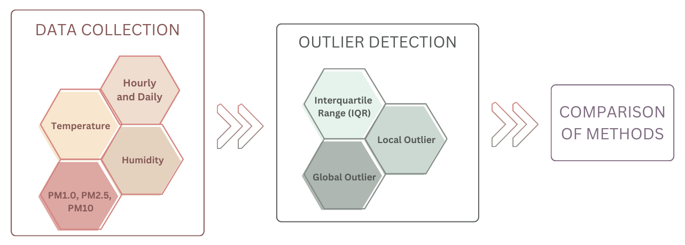
Low-cost environmental sensors in smart cities play a critical role in monitoring the environment, offering real-time information for urban management. The reliability of smart sensors remains uncertain, since sensors may report outliers when malfunctioning, or due to anomalies in the environment or extreme occurrences, which might skew the analysis if not treated carefully. The study seeks to support the distinction between likely sensor anomalies and spatially coherent environmental events by comparing different outlier detection methods: Interquartile Range (IQR), Local Outlier, and Global Outlier. The IQR method identifies temporal outliers based on historical data, whereas Local and Global methods use the spatial dimension, calculating the deviations from the local and global averages, respectively. During wildfire incidents near Athens, Greece, in August 2021, the methods were applied on environmental data from the PurpleAir sensor platform, which measures PM1.0, PM2.5, PM10.0, temperature and relative humidity. The IQR approach performed well in depicting short-term pollution peaks temporally associated with the wildfire period. The Local Outlier approach identifies a higher rate of local extreme values, thus suggesting sensitivity to localized environmental variability, while the Global Outlier method is more appropriate for widespread events.
Highlights:
- Evaluates outlier detection approaches applied to low-cost environmental sensor data in a wildfire pollution context.
- Three outlier detection methods are compared, IQR, Local Outlier and Global Outlier.
- Application of these methods to PurpleAir sensor data during August 2021 wildfires in Athens, Greece.
- IQR captured pollution-related spikes; Local Outlier indicated localized deviations; Global Outlier highlighted broader spatial patterns.
Downloads




References
- Aggarwal, C. C. (2017). Outlier Analysis. Springer International Publishing. https://doi.org/10.1007/978-3-319-47578-3
- Alghushairy, O., Alsini, R., Soule, T., & Ma, X. (2020). A Review of Local Outlier Factor Algorithms for Outlier Detection in Big Data Streams. Big Data and Cognitive Computing, 5, 1. https://doi.org/10.3390/bdcc5010001
- Anggraini, T. S., Irie, H., Sakti, A. D., & Wikantika, K. (2024). Machine learning-based global air quality index development using remote sensing and ground-based stations. Environmental Advances, 15, 100456. https://doi.org/10.1016/j.envadv.2023.100456
- Ayadi, A., Ghorbel, O., Obeid, A. M., & Abid, M. (2017). Outlier detection approaches for wireless sensor networks: A survey. Computer Networks, 129, 319–333. https://doi.org/10.1016/j.comnet.2017.10.007
- Barkjohn, K. K., Yaga, R., Thomas, B., Schoppman, W., Docherty, K. S., & Clements, A. L. (2025). Evaluation of Long-Term Performance of Six PM2.5 Sensor Types. Sensors, 25(4), 1265. https://doi.org/10.3390/s25041265
- Barnett, V., & Lewis, T. (1994). Outliers in statistical data (3rd ed.). John Wiley & Sons, Ltd.
- Bobbia, M., Misiti, M., Misiti, Y., Poggi, J. M., & Portier, B. (2015). Spatial outlier detection in the PM10 monitoring network of Normandy (France). Atmospheric Pollution Research, 6(3), 476–483. https://doi.org/10.5094/APR.2015.053
- Braun, R. A. & Fraser, M. P. (2025). Influence of wildfire smoke on summertime surface air quality in an urban desert region. Atmospheric Environment, 358. https://doi.org/10.1016/j.atmosenv.2025.121297
- Bulot, F. M. J., Johnston, S. J., Basford, P. J., Easton, N. H. C., Apetroaie-Cristea, M., Foster, G. L., Morris, A. K. R., Cox, S. J., & Loxham, M. (2019). Long-term field comparison of multiple low-cost particulate matter sensors in an outdoor urban environment. Scientific Reports, 9(1), 7497. https://doi.org/10.1038/s41598-019-43716-3
- Chen, L. J., Ho, Y. H., Hsieh, H. H., Huang, S. T., Lee, H. C., & Mahajan, S. (2018). ADF: An Anomaly Detection Framework for Large-Scale PM2.5 Sensing Systems. IEEE Internet of Things Journal, 5(2), 559–570. https://doi.org/10.1109/JIOT.2017.2766085
- Couzo, E., Valencia, A., & Gittis, P. (2024). Evaluation and Correction of PurpleAir Temperature and Relative Humidity Measurements. Atmosphere, 15(4). https://doi.org/10.3390/atmos15040415
- de Azevedo, L. J. de M., Estrella, J. C., Delbem, A. C. B., Meneguette, R. I., Reiff-Marganiec, S., & de Andrade, S. C. (2022). Analysis of Spatially Distributed Data in Internet of Things in the Environmental Context. Sensors, 22(5), 1693. https://doi.org/10.3390/s22051693
- Dong, J., Goodman, N., Carre, A., & Rajagopalan, P. (2025). Calibration and validation-based assessment of low-cost air quality sensors. Science of the Total Environment, 977, 179364. https://doi.org/10.1016/j.scitotenv.2025.179364
- EFFIS – European Forest Fire Information System. (2021). MODIS Burnt Areas: Rapid Damage Assessment (RDA) Module of EFFIS. Data provided on 20 June 2024 via email from: https://forest-fire.emergency.copernicus.eu/apps/data.request.form/
- El-Shafeiy, E., Alsabaan, M., Ibrahem, M. I., & Elwahsh, H. (2023). Real-Time Anomaly Detection for Water Quality Sensor Monitoring Based on Multivariate Deep Learning Technique. Sensors, 23(20), 8613. https://doi.org/10.3390/s23208613
- Giannaros, T. M., Papavasileiou, G., Lagouvardos, K., Kotroni, V., Dafis, S., Karagiannidis, A., & Dragozi, E. (2022). Meteorological Analysis of the 2021 Extreme Wildfires in Greece: Lessons Learned and Implications for Early Warning of the Potential for Pyroconvection. Atmosphere, 13(3). https://doi.org/10.3390/atmos13030475
- Graça, D., Reis, J., Gama, C., Monteiro, A., Rodrigues, V., Rebelo, M., Borrego, C., Lopes, M., & Miranda, A. I. (2023). Sensors Network as an Added Value for the Characterization of Spatial and Temporal Air Quality Patterns at the Urban Scale. Sensors, 23(4). https://doi.org/10.3390/s23041859
- Hayward, I., Martin, N. A., Ferracci, V., Kazemimanesh, M., Jude, S., Walton, C., Nasir, Z. A., Kumar, P. (2025). Comprehensive comparison of correction techniques for low-cost air quality sensors: the impact of device type and deployment environment. npj Climate and Atmospheric Science, 8, 389. https://doi.org/10.1038/s41612-025-01231-5
- Hayward, I., Martin, N. A., Ferracci, V., Kazemimanesh, M., & Kumar, P. (2024). Low-Cost Air Quality Sensors: Biases, Corrections and Challenges in Their Comparability. Atmosphere, 15(12), 1523. https://doi.org/10.3390/atmos15121523
- Janeja, V. P., Adam, N. R., Atluri, V., & Vaidya, J. (2010). Spatial neighborhood based anomaly detection in sensor datasets. Data Mining and Knowledge Discovery, 20(2), 221–258. https://doi.org/10.1007/s10618-009-0147-0
- Kamal, S., Ramadan, R., & El-Refai, F. (2016). Smart outlier detection of wireless sensor network. Facta Universitatis - Series: Electronics and Energetics, 29(3), 383–393. https://doi.org/10.2298/FUEE1603383K
- Kaskaoutis, D. G., Petrinoli, K., Grivas, G., Kalkavouras, P., Tsagkaraki, M., Tavernaraki, K., Papoutsidaki, K., Stavroulas, I., Paraskevopoulou, D., Bougiatioti, A., Liakakou, E., Rashki, A., Sotiropoulou, R. E. P., Tagaris, E., Gerasopoulos, E., & Mihalopoulos, N. (2024). Impact of peri-urban forest fires on air quality and aerosol optical and chemical properties: The case of the August 2021 wildfires in Athens, Greece. Science of The Total Environment, 907, 168028. https://doi.org/10.1016/j.scitotenv.2023.168028
- Keshtkar, M., Heidari, H., Moazzeni, N., & Azadi, H. (2022). Analysis of changes in air pollution quality and impact of COVID-19 on environmental health in Iran: application of interpolation models and spatial autocorrelation. Environmental Science and Pollution Research, 29(25), 38505–38526. https://doi.org/10.1007/s11356-021-17955-9
- Levy Zamora, M., Xiong, F., Gentner, D., Kerkez, B., Kohrman-Glaser, J., & Koehler, K. (2019). Field and Laboratory Evaluations of the Low-Cost Plantower Particulate Matter Sensor. Environmental Science and Technology, 53(2), 838–849. https://doi.org/10.1021/acs.est.8b05174
- Liang, C.-J., & Yu, P.-R. (2021). Assessment and Improvement of Two Low-Cost Particulate Matter Sensor Systems by Using Spatial Interpolation Data from Air Quality Monitoring Stations. Atmosphere, 12(3), 300. https://doi.org/10.3390/atmos12030300
- Masoom, A., Fountoulakis, I., Kazadzis, S., Raptis, I.-P., Kampouri, A., Psiloglou, B. E., Kouklaki, D., Papachristopoulou, K., Marinou, E., Solomos, S., Gialitaki, A., Founda, D., Salamalikis, V., Kaskaoutis, D., Kouremeti, N., Mihalopoulos, N., Amiridis, V., Kazantzidis, A., Papayannis, A., Zerefos, C. S., & Eleftheratos, K. (2023). Investigation of the effects of the Greek extreme wildfires of August 2021 on air quality and spectral solar irradiance. Atmospheric Chemistry and Physics, 23(14), 8487–8514. https://doi.org/10.5194/acp-23-8487-2023
- Miao, L., Liu, C., Yang, X., Kwan, M. P., & Zhang, K. (2022). Spatiotemporal heterogeneity analysis of air quality in the Yangtze River Delta, China. Sustainable Cities and Society, 78. https://doi.org/10.1016/j.scs.2021.103603
- Munir, S., Mayfield, M., Coca, D., Jubb, S. A., & Osammor, O. (2019). Analysing the performance of low-cost air quality sensors, their drivers, relative benefits and calibration in cities—a case study in Sheffield. Environmental Monitoring and Assessment, 191(2), 94. https://doi.org/10.1007/s10661-019-7231-8
- Ottosen, T.-B., & Kumar, P. (2019). Outlier detection and gap filling methodologies for low-cost air quality measurements. Environmental Science: Processes & Impacts, 21(4), 701–713. https://doi.org/10.1039/C8EM00593A
- Papayiannis, G. I., Psarakis, S., & Yannacopoulos, A. N. (2023). Modelling of Functional Profiles and Explainable Shape Shifts Detection: An Approach Combining the Notion of the Fréchet Mean with the Shape-Invariant Model. Mathematics, 11(21), 4466. https://doi.org/10.3390/math11214466
- Poornima, I. G. A., & Paramasivan, B. (2020). Anomaly detection in wireless sensor network using machine learning algorithm. Computer Communications, 151, 331–337. https://doi.org/10.1016/j.comcom.2020.01.005
- Reid, C. E., Brauer, M., Johnston, F. H., Jerrett, M., Balmes, J. R., & Elliott, C. T. (2016). Critical Review of Health Impacts of Wildfire Smoke Exposure. Environmental Health Perspectives, 124(9), 1334–1343. https://doi.org/10.1289/ehp.1409277
- Sánchez-Lasheras, F., Ordóñez-Galán, C., García-Nieto, P. J., & García-Gonzalo, E. (2020). Detection of outliers in pollutant emissions from the Soto de Ribera coal-fired power plant using functional data analysis: a case study in northern Spain. Environmental Science and Pollution Research, 27(1), 8–20. https://doi.org/10.1007/s11356-019-04435-4
- Slongo, J., Lindino, C., Martins, L. D., Spanhol, F. A., Carneiro, E., & Camargo, E. T. (2024). Evaluation of low-cost sensors to integrate in a water quality monitor for real-time measurements. Environmental Monitoring and Assessment, 196(8), 716. https://doi.org/10.1007/s10661-024-12884-9
- Tagle, M., Rojas, F., Reyes, F., Vásquez, Y., Hallgren, F., Lindén, J., Kolev, D., Watne, Å. K., & Oyola, P. (2020). Field performance of a low-cost sensor in the monitoring of particulate matter in Santiago, Chile. Environmental Monitoring and Assessment, 192(3). https://doi.org/10.1007/s10661-020-8118-4
- Tukey, J. W. (1977). Exploratory data analysis. Addison-Wesley.
- Wei, Y., Jang-Jaccard, J., Sabrina, F., & Alavizadeh, H. (2020). Large-Scale Outlier Detection for Low-Cost PM₁₀ Sensors. IEEE Access, 8, 229033–229042. https://doi.org/10.1109/ACCESS.2020.3043421
- Xin, L., Shaoliang, Z., & Pulin, Z. (2015). Spatial Outlier Detection of CO2 Monitoring Data Based on Spatial Local Outlier Factor. Journal of Engineering Science and Technology Review, 8(5), 110-116. https://doi.org/10.25103/jestr.085.15
- Zafeirelli, S., & Kavroudakis, D. (2024). Comparison of outlier detection approaches in a Smart Cities sensor data context. International Journal on Smart Sensing and Intelligent Systems, 17(1). https://doi.org/10.2478/ijssis-2024-0004
- Zhang, Y., Hamm, N. A. S., Meratnia, N., Stein, A., van de Voort, M., & Havinga, P. J. M. (2012). Statistics-based outlier detection for wireless sensor networks. International Journal of Geographical Information Science, 26(8), 1373–1392. https://doi.org/10.1080/13658816.2012.654493
- Zhang, Y., Meratnia, N., & Havinga, P. (2010). Outlier detection techniques for wireless sensor networks: A survey. IEEE Communications Surveys and Tutorials, 12(2), 159–170. https://doi.org/10.1109/SURV.2010.021510.00088
- Zusman, M., Schumacher, C. S., Gassett, A. J., Spalt, E. W., Austin, E., Larson, T. v., Carvlin, G., Seto, E., Kaufman, J. D., & Sheppard, L. (2020). Calibration of low-cost particulate matter sensors: Model development for a multi-city epidemiological study. Environment International, 134. https://doi.org/10.1016/j.envint.2019.105329